MohammedAmin.com
Serious writing for
serious readers
Summary
1 January 2012
As a partner in PricewaterhouseCoopers, one of my responsibilities was counselling members of staff who reported to me regarding furthering their career ambitions. That naturally involved discussing what junior members of the tax practice needed to do to become more senior.
Of course one fundamental requirement was to become more knowledgeable about the tax system and more skilled in applying that knowledge to solve clients' tax problems. However, particularly as the individual becomes more senior, that is not enough.
A key requirement for attaining a senior position in PricewaterhouseCoopers, or indeed any other organisation, is having an understanding of commercial life, the major business issues of our time, industry trends etc. In turn this knowledge of what is happening in the commercial world cannot be complete without a deep understanding of politics both domestic and international, and social and demographic trends.
When the junior members of staff asked me how they could attain such knowledge, I invariably gave them the same advice, which was to recommend reading two publications.
In retirement I still regularly find myself giving advice to younger people on career progression. However they are now in a variety of industries, both financial and non-financial.
Nevertheless the career issues they face are fundamentally the same as at PricewaterhouseCoopers. For example if your speciality is computing, you can rise to a particular level simply by being skilled at writing code and understanding the computer software being used. However in most organisations to occupy a senior position you need the same knowledge of commercial life and politics (understood in the widest sense) mentioned above. It is not sufficient to simply be good at your technical specialism.
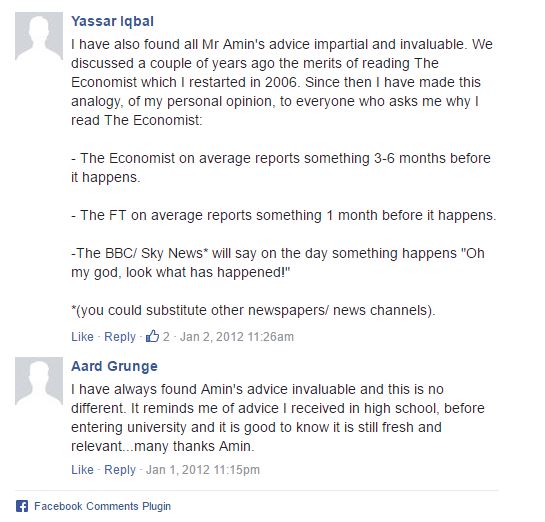
In most cases the people that I advise do not have enough time to read "The Financial Times" daily. Also, much of the cover price represents payment for the financial market data in the newspaper which few people need. Accordingly I invariably recommend reading "The Economist".
For many years, "The Economist" ran a poster campaign which had a variety of posters with the same theme, namely that reading “The Economist” will boost your career; a sentiment which I share completely.
While I was at PricewaterhouseCoopers, as a partner, I was entitled to receive a copy of "The Financial Times" each day paid for by the firm.
Accordingly I did not subscribe to "The Economist" but whenever I needed to buy something to read while travelling, always purchased that publication. In retirement I initially relied upon reading free electronic newspaper material, and used to receive a daily email from "The Times" newspaper. After "The Times" installed a pay wall, I started reading the electronic "Daily Telegraph" for a couple of months as that was still free.
Then I had an epiphany.
I asked myself "Why are you reading lower quality material that you never read before just because it is free?"
I then took out a premium electronic subscription to "The Financial Times" which gives me electronic access to a full replica of the daily newspaper, along with access to the electronic archive and the iPhone and iPad applications with all of the content.
I also subscribed to "The Economist" which means that the printed weekly newspaper is delivered to my house in Manchester. As I spend most of my time in my London flat, my subscription entitles me to download the full weekly newspaper to my iPhone and iPad applications. In practice, much of my reading of "The Economist" is done on my iPhone while travelling on London Underground.
For most people, "The Financial Times" is probably overkill even though it has the best quality of domestic and foreign news coverage. However I recommend "The Economist" to almost everyone who cares about their career.
It is also a very good read and even if you are not career minded you should be reading the best quality of news coverage rather than inferior material just because it is cheaper or free.
Ultimately, you become what you read.
Follow @Mohammed_Amin